Counting Citations or Inflating Influence? Trends in Urban Planning Citation Inflation

Abstract

Citation-based metrics play a growing role in evaluating scholarly impact, yet rising citation counts may reflect not only accumulation over time but also inflationary dynamics in the pace of citation generation. This study examines citation patterns among tenure-track and tenured faculty in U.S. urban planning programs from 2015 to 2024 using a dual stock-flow perspective. Cumulative citation totals (stock) are analyzed to document stratification by academic rank and institutional context. In contrast, annual citation accrual (flow), the year-to-year change in citations, is used to assess whether citation rates themselves are increasing over time. To avoid distortions associated with early baseline alignment and profile corrections in Google Scholar, primary flow analyses focus on the post-transition period from 2018 to 2024. Descriptive trends and multivariate models show that median and upper-tail annual citation accrual increase systematically over this period, even after controlling for rank, institutional classification, gender, and career-stage proxies. These patterns indicate a robust period effect consistent with inflation-like dynamics in the field’s citation environment. By distinguishing accumulation from acceleration, the study demonstrates that recent growth in citations in urban planning reflects not only cumulative advantage but also an intensifying pace of citation accumulation, with important implications for research evaluation in applied and interdisciplinary disciplines.

Download paper here: 10.13140/RG.2.2.32728.25601

Posted in Uncategorized | Leave a comment

Preparing Your Planning Agency for AI

I’m excited to share that I’m working with Planetizen on a new professional development class, Preparing Your Planning Agency for AI.

AI tools are already entering planning workflows across the public sector, often before agencies have developed clear governance, internal guidance, or shared implementation practices. This 6-week class walks through AI readiness. Space is limited. Sign up today at: https://www.planetizen.com/ai-class

Posted in Uncategorized | 1 Comment

Getting started with AI, part 2: What some planners are actually saying

Five practicing planners offer their advice for diving — cautiously — into using AI in their day-to-day work. See my column at: https://www.planetizen.com/blogs/137643-getting-started-ai-part-2-what-some-planners-are-actually-saying

Posted in Uncategorized | Leave a comment

What the Data Center Boom Means for Planners

A few thoughts on the increasing concerns about data centers as part of the AI boom. Read it on Planetizen at: https://www.planetizen.com/blogs/137025-what-data-center-boom-means-planners

Posted in AI, data centers, planning, technology | Leave a comment

Winter 2026 Urban Planning Citation Update

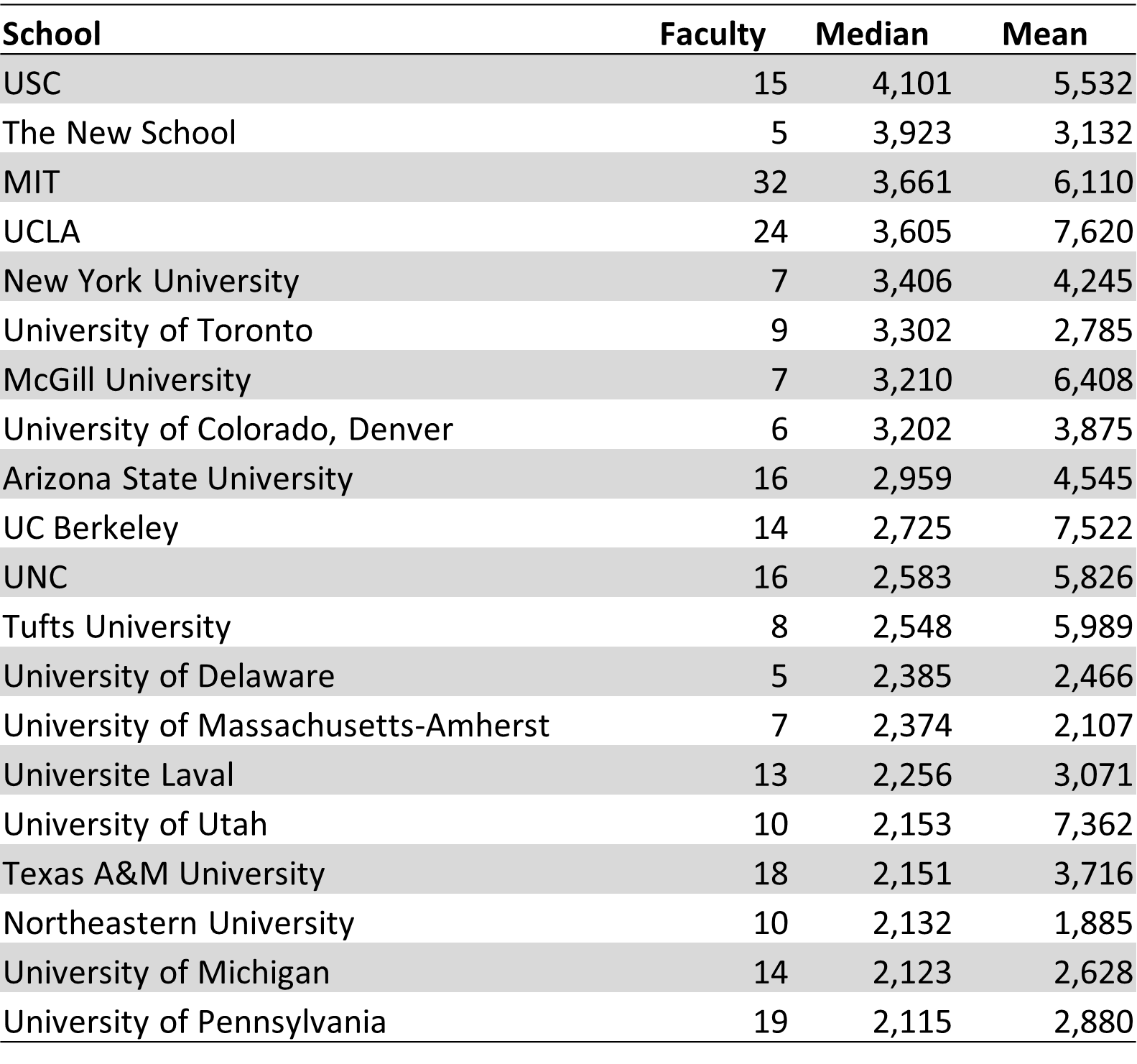
The updated citation data have just been posted at ScholarMetrics. Thanks to those of you who provided corrections, updates, and other faculty information. As mentioned before, there is no (easy) way to provide real-time updates due to Google Scholar limitations. I scrape Google Scholar Profiles for faculty who maintain them (about 80% of the 1,052), and then I use Harzing’s Publish or Perish to manually search publications and metrics for those who don’t have profiles. I focus on active, full-time, tenure-track faculty only because program comparisons are intended to reflect current faculty activities. This means that adjuncts, retired, emeritus, lecturers, etc., are not included because the expectations for scholarly productivity differ from those for tenured or tenure-track faculty. Links to previous years and more background are provided at Scholarmetrics. Please let me know if you have any comments or suggestions at: twsanchez@tamu.edu.

Top 20 Schools by Median Citations

Posted in Uncategorized | Leave a comment

AI for Planners Explained: Urban Digital Twins

A lot of recent conversations about artificial intelligence (AI) in urban planning have focused on language and text-related data. AI can summarize public comments, draft memos, scan reports, and help planners make sense of large amounts of information, typically text. In other words, AI is largely assisting the profession through words. See the Planetizen column at: https://www.planetizen.com/blogs/136842-ai-planners-explained-urban-digital-twins?amp

Posted in AI, planning, technology, urban, urban digital twins | Tagged , , | Leave a comment

The Dos and Don’ts of Using AI in Community Engagement for Urban Planners

AI can help planners make sense of lots of community input and hear from those who don’t usually show up. But it shouldn’t replace real conversations. Be upfront about how stakeholders’ input is used and ensure the process remains fair. In short, AI can be super helpful, but only if planners use it thoughtfully. https://www.planetizen.com/blogs/136462-dos-and-donts-using-ai-community-engagement-urban-planners

Posted in AI, planning | Tagged , , | Leave a comment

When “Neutrality” Becomes Blindness: The Perils of Censoring Race, Class, and Gender Data in Urban Planning

Political pushback against DEI is igniting right at the moment that AI is rising in urban planning. If we don’t fight it, the results could be catastrophic. See my Planetizen column here.

Posted in AI, diversity, equity, ethics | Leave a comment

Will Urban Planners Lose Their Jobs to AI?

AI can already draft policy briefs, summarize reports, and even sketch out scenarios, work that once performed by interns and junior planners. So what happens when the “training ground” for future planning professionals disappears? My latest Planetizen column asks whether planners are on the verge of being sidelined by their own tools, or whether we’ll take the lead in strategizing about how AI will reshape our field. https://www.planetizen.com/blogs/136043-will-urban-planners-lose-their-jobs-ai

Posted in AI, planning, technology | Tagged , , | Leave a comment

Summer 2025 Urban Planning Citation Update

The updated citation data have just been posted at ScholarMetrics. Thanks to those of you who provided corrections, updates, and other faculty information. As mentioned before, there is no (easy) way to provide real-time updates due to Google Scholar limitations. I scrape Google Scholar Profiles for faculty who maintain them (about 80% of the 1,048), and then I use Harzing’s Publish or Perish to manually search publications and metrics for those who don’t have profiles. I focus on active, full-time, tenure-track faculty only because program comparisons are intended to reflect current faculty activities. This means adjuncts, retired, emeritus, lecturers, etc., are not included because the expectations for scholarly productivity are not the same as for tenured or tenure-track faculty. Links to previous years and more background are provided at Scholarmetrics. Please let me know if you have any comments or suggestions at: twsanchez@tamu.edu.

Top schools by median citations

Top faculty by total citations and H-Index

Posted in academic visibility, Citation analysis, Google Scholar, planning, publications | Tagged , , | Leave a comment